Home > News > Latest News >2026 International Tourism and Hospitality Management Young Scholars Conference: Melody Cheang Shares Research on Generative AI–Supported Tourism Teaching Design
2026 International Tourism and Hospitality Management Young Scholars Conference:
Melody Cheang Shares Research on Generative AI–Supported Tourism Teaching Design
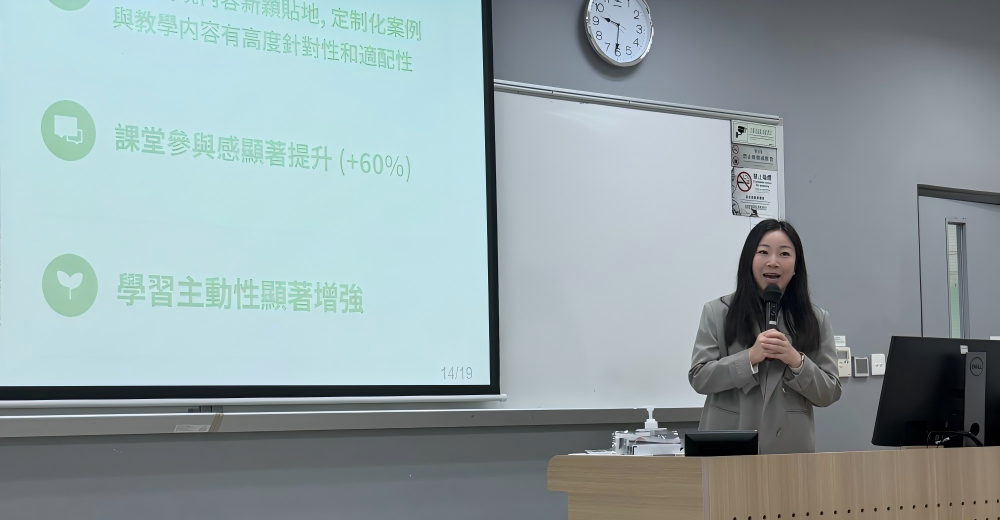
On 9 May 2026, the founder of InnoPandaMo, Ms. Melody Cheang, was invited to attend the 3rd International Emerging Scholars Conference in Tourism and Hospitality (IECR), organised by Macau University of Science and Technology. Speaking in her capacity as a researcher and educator, Ms. Cheang delivered a thematic presentation titled “An Action Research on Generative AI CE2 Supporting Tourism Course Design and Implementation: A Case-Based Learning Approach”.
In recent years, generative artificial intelligence has begun to enter university classrooms, with teachers experimenting with its use in lesson preparation, task design, classroom interaction and learning feedback. Compared with general lecture-based courses, tourism courses rely more heavily on concrete scenarios, role-based judgement and solution comparison. This places higher demands on the timeliness of case updates, the openness of discussion questions and the continuity of classroom interaction. Against this backdrop, Ms. Cheang emphasised that the key question is not whether AI can “generate content”, but whether it can be meaningfully embedded into existing teaching logic and become an effective assistant within case-based pedagogy.
Her study introduces CE2 into a postgraduate tourism course as part of case-teaching practice, focusing on its concrete applications before, during and after class. Using an action research framework of “plan – act – observe – reflect”, the research team implemented a four-stage iterative process: first, designing a three-stage “pre-class – in-class – post-class” application model; second, strictly following the model in teaching implementation, while collecting data, documenting classroom phenomena and recording student feedback; and finally, summarising classroom experience to refine and optimise the teaching plan for subsequent sessions.
According to the findings presented at IECR, AI-optimised case scenarios were more targeted and better aligned with course objectives, while accompanying exercises and classroom activities were more closely connected to the intended learning outcomes. Student participation and learning initiative both increased significantly. From the instructor’s perspective, teaching efficiency improved and lesson preparation time was reduced, enabling teachers to invest more energy in refining teaching strategies, designing interactive segments and addressing individual learner differences. At the same time, feedback cycles became much faster, allowing teachers to monitor student progress in real time, provide more timely guidance and build a more efficient teaching-feedback loop.
The study suggests that, by relieving teachers from repetitive tasks, generative AI creates additional space for innovative pedagogical design—for example, more complex role plays, cross-disciplinary project-based learning and richer experiential activities—thus enhancing the overall depth and quality of tourism courses. However, Ms. Cheang also pointed out that AI is not without limitations. The research identified issues such as occasional shortcomings in content authenticity, insufficient localisation of scenarios and the risk of students becoming overly dependent on AI tools.
Based on these observations, Ms. Cheang argued that the role of AI must be clearly defined: it is a powerful assistive tool, but it can never replace teachers. While AI frees up teachers’ time, it simultaneously raises expectations of their professional capabilities. In her view, educators should increasingly act as designers of learning experiences and shapers of values. In areas such as ethical judgement, emotional interaction and the handling of complex problems, teachers’ core competencies remain irreplaceable.
Looking ahead, Ms. Cheang believes that future teaching models will be characterised by deep human–AI collaboration. The AI-integrated teaching model developed in this study is intended to serve as a practical reference for educators and institutions exploring the integration of generative AI into tourism and hospitality education, and to inspire further innovation in curriculum design and implementation.